

4 ways the Autumn 2025 Budget could hit Gen X the hardest
With the Autumn Budget set to be delivered on 26 November 2025, many are speculating on how chancellor Rachel Reeves will close the UK’s fiscal gap.
Although the government has pledged not to increase Income Tax, VAT, or National Insurance (NI), it seems inevitable that some taxes will rise. Indeed, as reported by the Independent, Reeves has alluded to difficult choices ahead and refused to rule out significant changes.
While the details of the Budget remain uncertain, many of the rumoured policies could have a significant impact on those aged 45 to 60 years – otherwise known as “Gen X”.
Gen X’s finances are already being squeezed from all angles. Many are concerned about saving enough for retirement and paying off their mortgage. Meanwhile, a significant number are supporting family members – MoneyAge reports that around half of Gen X parents have adult children living with them, while 11% of Gen X are supporting elderly relatives.
As a result, many in Gen X may be feeling nervous as Budget rumours circulate. Understanding how potential changes could impact your finances can help you create a plan, although it’s important to remember that nothing is confirmed. So, it may be worth waiting for policy changes to be announced before taking potentially irreversible action.
Read on to learn four key changes Reeves could be planning and why they could hit Gen X the hardest.
1. Extending the freeze on Income Tax thresholds could harm your take-home pay
Data from the UK Parliament suggests that, as of April 2024, Gen X earned more on average than any other generation.
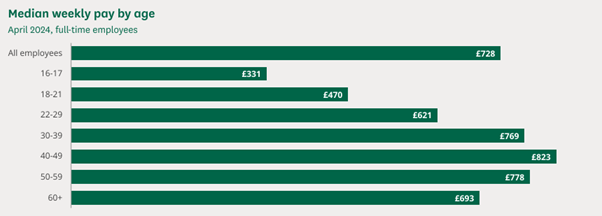
Source: UK Parliament
As a result, any increases to Income Tax could significantly affect Gen X. While the government renewed its manifesto pledge not to increase Income Tax in September 2025, as reported by the Independent, Reeves refused to rule out extending the freeze on Income Tax thresholds.
The amount you can earn tax-free, known as the Personal Allowance, has been frozen at £12,570 since April 2021. According to AJ Bell, if the Personal Allowance had risen with inflation, for 2025/26 it would be £15,550. As a result, many people are missing out on an additional £2,980 a year in tax-free earnings.
The thresholds that determine your Income Tax rate are also frozen at the following levels until 2028:
- Basic rate (20%): £12,571
- Higher rate (40%): £50,271
- Additional rate (45%): £125,141
These freezes are already proving costly, and many have speculated that the freeze could be extended to 2030. If so, according to IFA Magazine, someone who earned £80,000 a year in 2022 could pay £5,635 more in tax by 2030.
What’s more, as wages rise over time, many people will be pushed into higher tax brackets. For instance, if wage growth averaged 4% over the next few years, someone earning the average Gen X salary of £41,626 a year in 2024 could become a higher-rate taxpayer by 2029.
2. Changes to property tax could hinder Gen X’s mortgages repayments
Various rumours are circulating regarding potential changes to how properties are taxed. Some sources have speculated that Stamp Duty may be scrapped, with profits from selling your home being taxed instead. Similarly, some have claimed Council Tax is under review.
Property is a key concern for Gen X. According to the Intermediary, around three-quarters of Gen X owns a home. Of these, 27% are not confident they’ll repay their mortgage before they reach their State Pension Age of 67. Meanwhile, 34% have had to extend their mortgage term to manage monthly payments.
As such, any additional taxation of homeowners could hit this generation hard as they scramble to pay off their mortgages before retirement. However, it’s important to remember that nothing is confirmed and even the speculated changes are vague. In theory, changes to property taxes could work in your favour – it comes down to the policy details and your individual circumstances.
3. Pension rule changes could be concerning for a generation already worried about retirement
It’s speculated that the chancellor may cut the tax relief available on personal pension contributions as well as the tax-free lump sum allowance. The allowance is 25% of your pension, up to a maximum of £268,275 as of 2025/26.
Any changes that diminish the tax benefits of private pensions could potentially hit Gen X the hardest. Not only are they likely to still be contributing to their pensions, but some are on the cusp of retirement or have retired recently.
What’s more, PensionsAge reports that just 28% of Gen X say they’re on track to meet their retirement savings goals, compared to 40% across all working generations.
Meanwhile, the government has committed to retaining the triple lock until the end of this parliament. This ensures the new full State Pension rises each year by the rate of inflation, average earnings growth, or 2.5%, whichever is highest.
However, according to MoneyWeek, the State Pension could exceed the frozen threshold for Income Tax as soon as 2027, increasing the pension tax burden further for retirees.
4. Inheritance Tax changes could diminish Gen X’s safety net
Inheritance Tax (IHT) is believed to be a prime target for the government as it looks to boost revenue. In particular, some sources suggest Reeves could tighten the rules for gifting. This could include introducing a lifetime cap on the amount you can give away tax-free or extending the current seven-year period after which gifts become exempt from IHT.
Additionally, as of 2025/26, the nil-rate band is frozen at £325,000 and the residence nil-rate band is frozen at £175,000. These freezes are currently set to be lifted in 2030, but some have suggested they could be extended further.
In effect, this would mean the amount you can inherit tax-free from a single estate would stagnate while inflation rises. According to MoneyWeek, if they had risen with inflation, the nil-rate band would be over £517,000 in 2025/26, while the residence nil-rate band would be over £221,000.
Over the next 30 years, as reported by Unbiased, up to £7 trillion is expected to be transferred from one generation to the next, mainly from baby boomers to Gen X and millennials.
With Gen X therefore likely to be the next generation to receive an inheritance, any IHT changes could have a significant impact. This is especially true for a generation in need of a financial safety net as they near retirement.
Find out how I can help
While Budget rumours can be overwhelming, it’s important to remain calm. No policy changes have been confirmed at the time of writing, so any decisions you make before the Budget is delivered in November may turn out to be unnecessary.
If you’re concerned about how any speculated changes could impact your finances, I can assist you in understanding your current position and create a plan to help protect your finances once the Budget has been delivered.
Email Marnel.Stafford@fosterdenovo.com, or call 07305 970959 or 0207 469 2800, to find out more about how I can help you.
Please note
This article is for general information only and does not constitute advice. The information is aimed at retail clients only.
All information is correct at the time of writing and is subject to change in the future.
Please do not act based on anything you might read in this article. All contents are based on our understanding of HMRC legislation, which is subject to change.
The Financial Conduct Authority does not regulate estate planning or tax planning.
A pension is a long-term investment not normally accessible until 55 (57 from April 2028). The fund value may fluctuate and can go down, which would have an impact on the level of pension benefits available. Past performance is not a reliable indicator of future performance.
The tax implications of pension withdrawals will be based on your individual circumstances. Thresholds, percentage rates, and tax legislation may change in subsequent Finance Acts.
Your home may be repossessed if you do not keep up repayments on a mortgage or other loans secured on it.
Remember that taper relief only applies to gifts in excess of the nil-rate band. It follows that, if no tax is payable on the transfer because it does not exceed the nil-rate band (after cumulation), there can be no relief.
Taper relief does not reduce the value transferred; it reduces the tax payable as a consequence of that transfer.